
Jim Stark Jim Stark
0 Course Enrolled • 0 Course CompletedBiography
OGA-032 Test Labs | OGA-032 Exam Overview
The OGA-032 exam questions are the ideal and recommended study material for quick and easiest ArchiMate 3 Part 2 Exam (OGA-032) exam dumps preparation. The ArchiMate 3 Part 2 Exam (OGA-032) practice questions are designed and verified by qualified and renowned The Open Group Certification Exams trainers. They work closely and check all The Open Group OGA-032 Exam Dumps step by step. They also ensure the best possible answer for all OGA-032 exam questions and strive hard to maintain the top standard of ArchiMate 3 Part 2 Exam (OGA-032) exam dumps all the time.
Our top priority is to help every customer in cracking the ArchiMate 3 Part 2 Exam (OGA-032) test. Therefore, we have created these formats so that every applicant can prepare successfully for the ArchiMate 3 Part 2 Exam (OGA-032) exam on the first attempt. We are aware that the cost for the registration of the The Open Group OGA-032 examination is not what everyone can pay. After paying the hefty ArchiMate 3 Part 2 Exam (OGA-032) test registration fee, applicants usually run on a tight budget. This is why PracticeTorrent provides you with the ArchiMate 3 Part 2 Exam (OGA-032) real questions with up to 1 year of free updates.
100% Pass Quiz 2025 Marvelous The Open Group OGA-032: ArchiMate 3 Part 2 Exam Test Labs
At PracticeTorrent, we strive hard to offer a comprehensive ArchiMate 3 Part 2 Exam (OGA-032) exam questions preparation material bundle pack. The product available at PracticeTorrent includes ArchiMate 3 Part 2 Exam (OGA-032) real dumps pdf and mock tests (desktop and web-based). Practice exams give an experience of taking the ArchiMate 3 Part 2 Exam (OGA-032) actual exam.
The Open Group ArchiMate 3 Part 2 Exam Sample Questions (Q11-Q16):
NEW QUESTION # 11
Please read this scenario prior to answering the question
ArchiAir Catering Services (ACS) manages the catering services for ArchiAir, a leading airline. ACS is the sole catering supplier for all ArchiAir flights, and its services include full provisioning to the aircraft.
Currently, ACS operates three central production facilities, supported by distribution hubs and local pre-flight production facilities. The central production facilities are responsible for producing standardized non-food materials (such as plates, cutlery, and boxes), non-perishable food products, and key ingredients required by the local production facilities. These materials are subsequently distributed to the distribution hubs, whichalso serve as warehouses for the local production facilities. Within the local production facilities, multiple production machines are utilized, each featuring dedicated workstations for chefs and quality inspectors. Most of the local production facilities employ fully automated assembly lines, including built-in packaging stations. The loaded service trolleys are then transported to the aircraft using small lorries.
In response to investor pressure for ArchiAir to reduce its carbon footprint, the CEO of ACS has announced a plan to address this environmental concern. Subsequently, the Ministry of Social Welfare and Health has enacted a law mandating a reduction in CO2 emissions from all production facilities by the end of the year. Additionally, the airline's decision to raise ticket prices due to escalating fuel costs has led to a decrease in passenger numbers. This, in turn, impacts the volume of non-food materials required from ACS. An intemal investigation has produced a report highlighting the potential benefits of centralizing production facilities and reducing the number of distribution centers. Such changes would result in lower CO2 emissions while still effectively meeting all the requirements of ArchiAir.
In addition to evaluating its supply chain to reduce its carbon footprint, ArchiAir is taking proactive steps to achieve a net zero carbon footprint for its IT operations. The Chief Information Officer (CIO) has identified two crucial requirements to support this endeavor. The first requirement involves switching to renewable energy for ACS facilities, which are often located in remote areas where traditional fuels are the primary source of energy. To align with sustainability goals, ArchiAir aims to transition these facilities to renewable energy sources. By utilizing renewable energy, ArchiAir can significantly reduce its reliance on traditional fuels and contribute to a greener operation. The second requirement pertains to the scalability of ArchiAir's IT operations, taking into account the airline's susceptibility to seasonal changes in demand. The CIO has observed notable disparities between sites that have additional blade servers and can scale their capacity, and sites that solely rely on the two mainframes housed in central facilities. A comprehensive report has revealed that the blade servers have a negligible impact on resource waste, whereas the mainframes are notorious for their power inefficiency, particularly during periods of low demand.
Refer to the Scenario
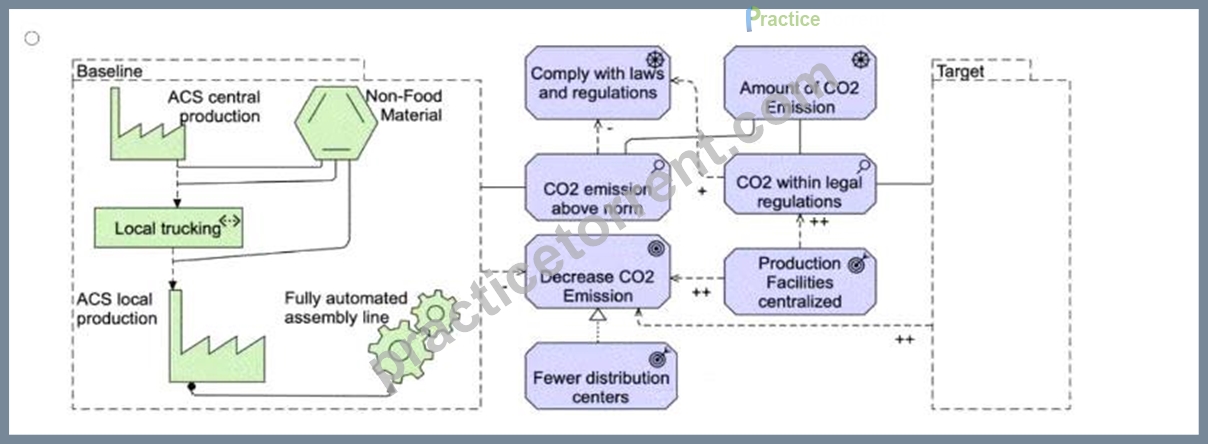
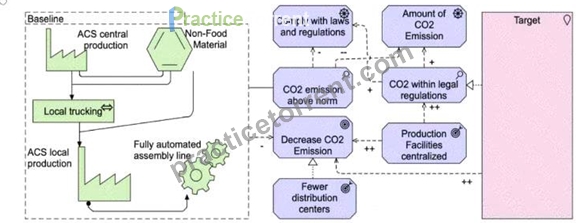
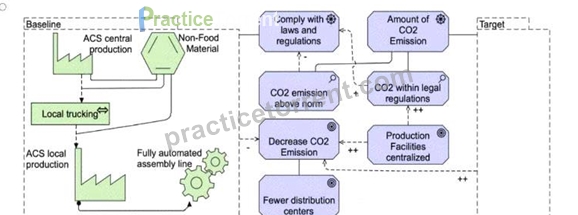
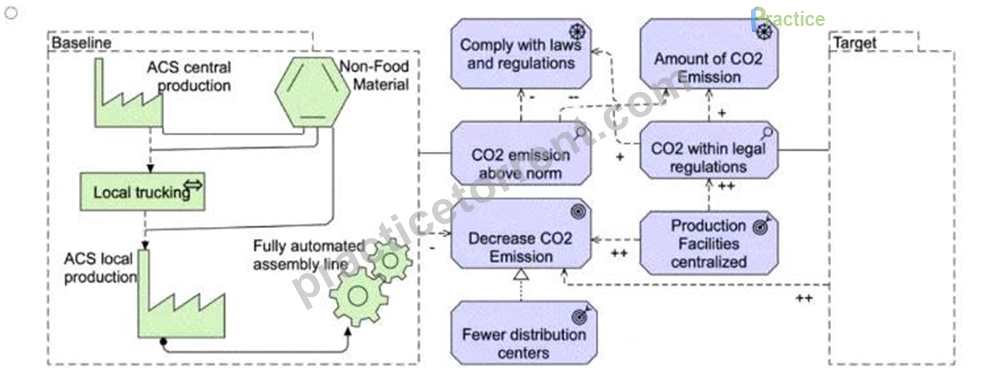
Which of the following answers best describes the proposed transition from baseline to target, including details of motivation for changes? Note that there is no need to show the details of the target state.
- A.
- B. A diagram of a process Description automatically generated
- C.
- D.
Answer: D
Explanation:
The correct answer isD, as it best describes the transition from the baseline to the target state, including the motivation for changes based on the scenario. Here's a detailed explanation of whyDis the most accurate model:
* Baseline and Target:
* TheBaselinestate in all answers correctly depicts the current structure of ACS's operations, including theACS Central Production,Local Trucking,ACS Local Production, andFully Automated Assembly Line.
* Dcaptures the essential transition from this baseline state to the target state by illustrating how the organization is aiming to decrease CO2 emissions, as required by the new regulations, and how they intend to centralize production facilities.
* Motivation for Changes (Decrease in CO2 Emissions):
* The CEO's plan to reduceCO2 emissionsis a critical driver for change. This is captured clearly in D, which shows the effects ofDecreasing CO2 Emissions,Complying with Laws and Regulations, andCentralizing Production Facilities.
* TheMinistry of Social Welfare and Health's lawmandating CO2 reductions is accurately reflected inD, showing compliance as part of the motivation.
* Dalso depicts the motivation to centralize production facilities, which helps reduce CO2 emissions and aligns with the internal report suggesting that fewer distribution centers can meet ACS's needs effectively.
* Business and Environmental Factors:
* The scenario also points out thatpassenger numbers have decreaseddue to rising ticket prices, which reduces the demand for non-food materials from ACS. This factor is linked to the centralization effort, as reducing the need for distribution centers can reduce costs while still meeting business needs.
* Dreflects this by linkingFewer Distribution CentersandCentralized Production Facilitiesto both decreased emissions and operational efficiency.
* Compliance with Laws and Regulations:
* Dshows a clear connection between compliance withCO2 Emission Lawsand theAmount of CO2 Emissionsgenerated by ACS, which is an essential driver of change in the scenario.
* The need to ensure that emissions are within the legal limit is modeled effectively inD, reflecting the scenario's requirement to meet regulatory expectations by the end of the year.
* Centralization of Production:
* The scenario suggests thatcentralizing productionis one way to reduce emissions and achieve operational efficiency. This is depicted clearly inD, whereProduction Facilities Centralized leads to both fewer distribution centers and a significant decrease in CO2 emissions.
* Dlinks the motivation for fewer distribution centers to environmental sustainability (CO2 reduction) as well as operational improvements.
* Comprehensive ArchiMate® 3 Compliance:
* Daligns well with ArchiMate® 3 standards. It models theMotivation Elementssuch as goals (e.g., Decrease CO2 Emissions), assessments (e.g.,CO2 Emission Above Norm), and requirements (e.
g.,Comply with Laws and Regulations) accurately.
* The relationships between these motivation elements are correctly depicted using ArchiMate® connectors like influences and associations, ensuring that the transition from baseline to target is clear and fully compliant with ArchiMate® 3 best practices.
Conclusion:AnswerDprovides the best representation of the proposed transition, focusing on the motivations for centralization and reduction of CO2 emissions. It accurately reflects the scenario's requirements, including legal compliance, environmental goals, and operational changes, all while following ArchiMate® 3 modeling standards.
NEW QUESTION # 12
Please read this scenario prior to answering the question
The ArchiSurance senior management, board members, customers, and major stockholders have expressed long-standing concerns regarding the business continuity risks associated with relying on a single data center.
Located in an area prone to
flooding, earthquakes, and occasional water leaks from the cafeteria above, the current data center has significant vulnerabilities.
To address these concerns and mitigate the risks, ArchiSurance has developed a comprehensive plan to relocate its existing data center to two separate ready-to-use data centers in different cities. As a major undertaking, the approval of the Board of Directors is required to proceed with the project.
The primary objectives of the data center move are to reduce the risk of business interruptions, reduce both planned and unplanned downtime for critical applications, and provide reassurance to ArchiSurance stakeholders. Ensuring minimal disruption during the transition is crucial. However, several constraints make the planned migration to the new data centers particularly challenging. Certain critical ArchiSurance applications cannot be offline for more than one hour, and any planned downtime must be restricted to specific four-hour windows on weekends. Additionally, the migration cannot take place during quarterly or year-end closing periods to avoid disrupting critical processing operations.
ArchiSurance management has devised a multi-phase data center transformation program to facilitate a smooth transition. Each phase is critical for establishing stable and fully functional data center configurations throughout the transformation process.
The initial phase entails detailed scheduling and planning to develop a comprehensive transformation plan aligned with ArchiSurance's timing and scheduling requirements. During the second phase, ArchiSurance will procure the necessary hardware and software for the new data centers, while also seeking refunds for the hardware and software in the current data center once it is decommissioned. The third phase involves setting up the new data centers and conducting parallel testing of the new hardware and software alongside the existing production environment. The transition between the old and new data centers occurs in the fourth phase, followed by the fifth phase, which is the decommissioning of the old data center. This involves returning the hardware and software to obtain the contracted refunds. Each phase, from the second to the fifth, is initiated once specific conditions outlined in the previous phase have been met.
Refer to the Scenario
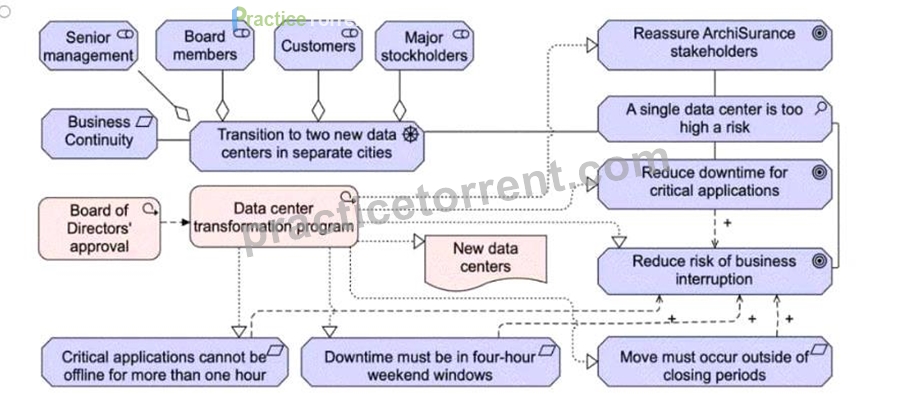
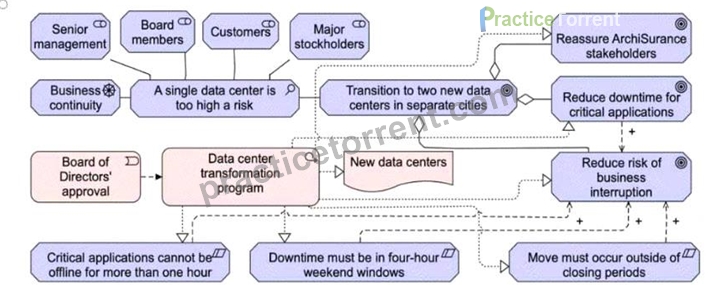
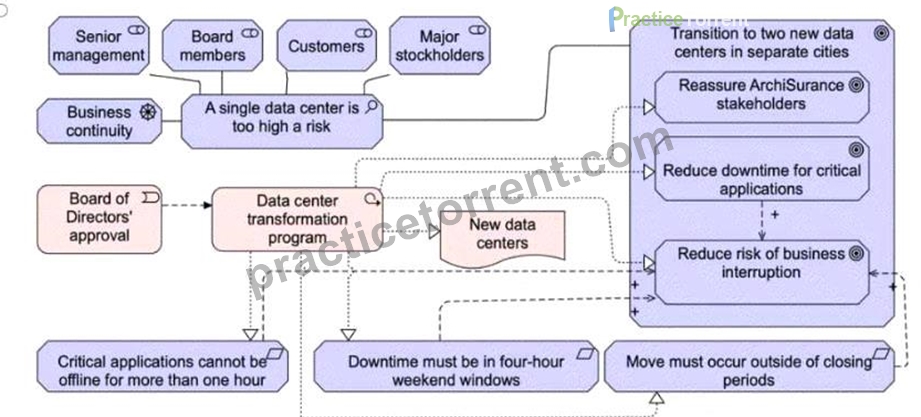
The IT department's leader has assigned you the task of creating a model to explain the rationale behind Archisurance's decision to transform its data center infrastructure. The model should show the concerns and motivations of the stakeholders involved. Additionally, it should outline the specific goals to be achieved through the data center transformation program, the associated deliverables, and the limitations that must be considered throughout the program's implementation.
Which of the following answers provides the best explanation?
- A. A diagram of a data center AI-generated content may be incorrect.
- B. A diagram of data center AI-generated content may be incorrect.
- C. A diagram of a data center AI-generated content may be incorrect.
- D. A diagram of data center AI-generated content may be incorrect.
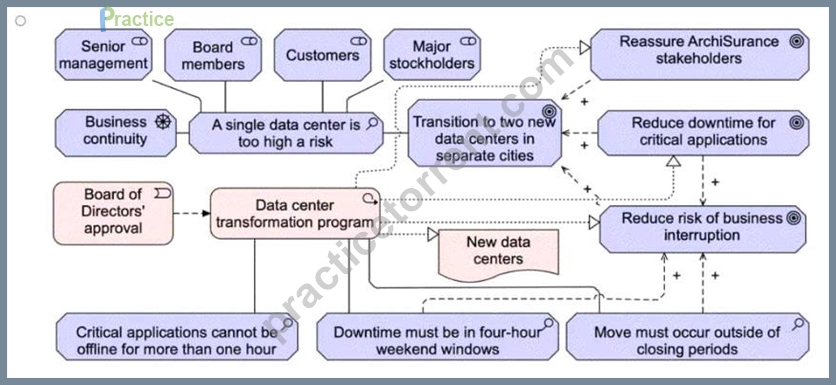
Answer: D
Explanation:
We need to identify the most accurate and complete model that explains:
* Stakeholder Concerns & Motivations- Including senior management, board members, customers, and stockholders.
* Objectives & Goals- Reducingbusiness risks, minimizingdowntime, andreassuring stakeholders.
* Deliverables- Thetransition to two new data centersanddata center transformation program.
* Constraints & Requirements-Planned downtime limits, critical application uptime requirements, and scheduling constraints.
Why C is the Best Choice:
#Includes all stakeholder concerns- Clearly representsbusiness continuity risksandthe rationale for transitioning to two new data centers.#Clearly defines the objectives- Reducingdowntime and risk of business interruption.#Shows key constraints-
* Critical applications cannot be offline for more than one hour.
* Downtime must be in four-hour weekend windows.
* The migration must avoid closing periods.#Links deliverables to objectives- Thedata center transformation programandnew data centersare clearly positioned as solutions.#Represents dependencies correctly- Showing how eachmotivation leads to a goal, which leads to a deliverable.
Why Not A, B, or D?
* A:Does not establish a strong link between theconcerns and the solutionclearly enough.
* B:The structure does not align well with the scenario requirements, andsome constraints and dependencies are missing.
* D:Overcomplicates some relationships anddoes not emphasize stakeholder concerns effectively.
NEW QUESTION # 13
Please read this scenario prior to answering the question
ArchiSurance has decided to leverage its financial expertise by offering defined contribution retirement plans.
Each trading day, ArchiSurance submits consolidated mutual fund trading transactions to a stock exchange on behalf of its retirement plan participants.
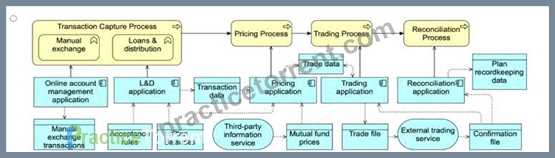
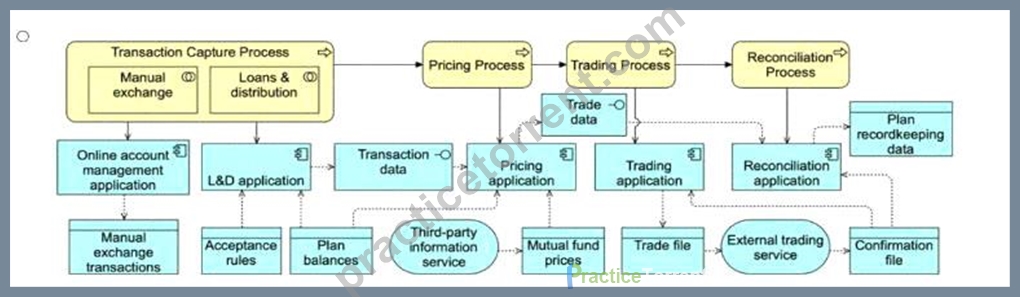
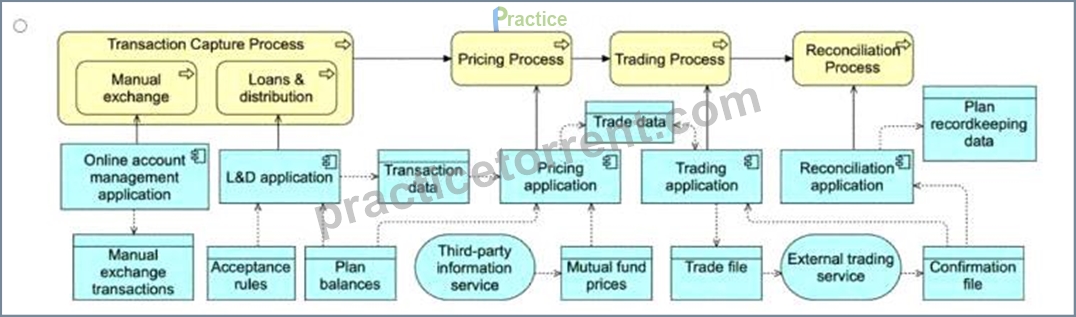
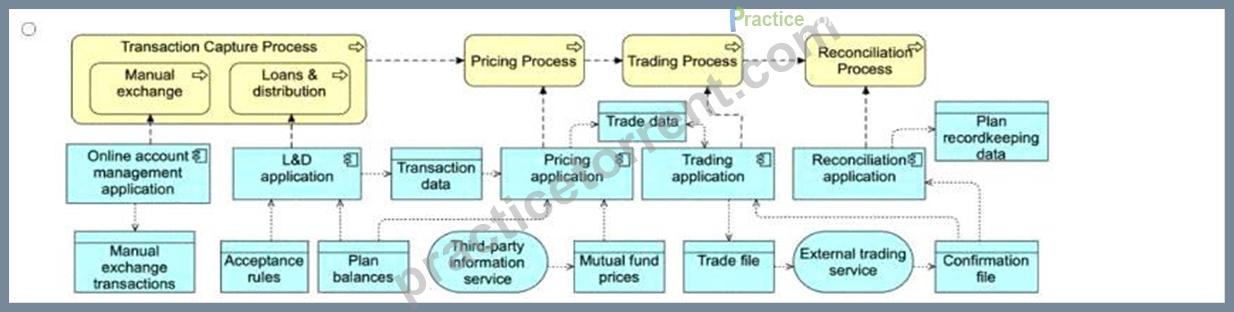
The daily mutual fund trading cycle consists of four key processes: Transaction capture, pricing, trading and reconciliation. Transaction capture consists of two sub-processes: manual exchange and loans and distributions (L&D). For transaction capture, retirement plan participants use an online account management application to enter manual fund exchange transactions. For L&D, plan participants use a separate application to enter requests. The L&D application determines whether the request can be fulfilled based on the mutual fund balances held in each plan balances and a setof business rules. Each day's captured manual exchange transactions accumulate in a transaction database.
ArchiSurance contracts with a third-party information service to receive a file of mutual fund prices at the close of each trading day. The pricing application uses this file to convert captured transaction into trades, and then validates each trade against the mutual fund balances held in each plan. The pricing application generates a trade file with the minimum number of trades necessary. The trading application sends this file to an external trading service.
When the trading application
receives a confirmation file back from the trading service, it causes the reconciliation application to update the plan recordkeeping database.
The account management and L&D applications are hosted on separate application server clusters. Each cluster is a physically separate host that runs application server software on a set of virtualized hosts. All of these applications use a database server infrastructure that is hosted on another separate cluster of virtualized servers also on a dedicated physical host. The pricing, consolidation, trading and reconciliation applications, however, are batch applications that run on the ArchiSurance mainframe computer. All application hosts are connected via a converged data center network (DCN), which also connects them to a storage area network (SAN) as well as a wide area network (WAN) that is used to communicate with the external trading service. The SAN includes two physically separate storage arrays, one of which holds data for all databases, and another that holds data for all files.
Refer to the Scenario
The systems analysts would like to better understand the business processes and applications for daily fund trading. You have been asked to describe the business processes and sub-processes, the applications that they use, the data objects accessed by those applications, and the external application services that access some of those data objects.
Which of the following is the best answer? Note that you are not required to model the business actors/roles.
- A.
- B.
- C.
- D.
Answer: B
Explanation:
In this scenario, the goal is to model thebusiness processes, theirsub-processes, theapplicationssupporting these processes, and thedata objectsthese applications access. Additionally, external services that access some of these data objects need to be shown. This includes capturing the key processes and their dependencies, as well as understanding how the applications interact with data and external services.
Key ArchiMate® 3.2 Concepts Applied:
* Business Processes and Sub-Processes:
* Transaction Capture Process: Consists of two sub-processes:
* Manual Exchange
* Loans & Distribution (L&D)This process is responsible for capturing transactions from users through different applications (Online Account Management, L&D Application).
* Pricing Process: This process uses theMutual Fund Pricesfrom a third-party service and the Plan Balancesto validate and price trades.
* Trading Process: This process generates aTrade Fileand interacts with an externalTrading Service.
* Reconciliation Process: This final process updates thePlan Recordkeeping Dataafter confirming trades from theExternal Trading Service.
* Applications and Data:
* Online Account Management ApplicationandL&D Application: These capture user inputs for transactions and maintainTransaction DataandPlan Balances.
* Pricing Application: UsesMutual Fund PricesandTransaction Datato generateTrade Data.
* Trading Application: SubmitsTrade Dataand receives aConfirmation Filefromthe external Trading Service.
* Reconciliation Application: Uses theConfirmation Fileto updatePlan Recordkeeping Data.
* External Application Services:
* Third-Party Information Service: ProvidesMutual Fund Prices.
* External Trading Service: Processes trades and returns aConfirmation File.
* Data Objects:
* Transaction Data: Captured by the transaction capture processes.
* Mutual Fund Prices: Received from the third-party service.
* Trade Data: Generated by the pricing and trading applications.
* Plan Recordkeeping Data: Updated by the reconciliation process after trade confirmation.
Why Option B is Correct:
* Option Bprovides the most complete and accurate representation of the scenario. It captures the business processes(Transaction Capture, Pricing, Trading, Reconciliation) and their sub-processes, while showing the appropriate connections to theapplicationsthat support these processes.
* It clearly depicts thedata objects(Transaction Data, Plan Balances, Trade File, Mutual Fund Prices, Plan Recordkeeping Data) and their flows between the processes and applications.
* The model also includes theexternal services(Third-Party Information Service and External Trading Service), showing how these interact with the internal applications and data objects.
* It accurately represents the flow ofTrade Datafrom thePricing Applicationto theTrading Application
, and the use ofMutual Fund Pricesby thePricing Process.
Why Other Options Are Incorrect:
* Option AandOption Dmiss some critical connections between the applications and the external services. They also lack clarity in how the data flows between the processes and applications.
* Option Cdoes not adequately represent the interaction between the applications and the external services (e.g., Third-Party Information Service), which is a key requirement in this scenario.
Conclusion:
Option Bprovides the best and most accurate description of the business processes, applications, data objects, and external services involved in ArchiSurance's daily fund trading operations, following ArchiMate® 3.2 standards for modeling business processes and applications.
NEW QUESTION # 14
Please read this scenario prior to answering the question
The IT Operations (IT Ops) department at ArchiSurance has five core responsibilities, each encompassing a dedicated business process: (1) Batch Operations (Batch Ops), (2) Online Operations (Online Ops), (3) Security Operations (Security Ops), (4) User Support and (5) Continuous Improvement. Service level agreements (SLAs) are in place for Batch Ops and Online Ops, and each Ops process generates monitoring data that is utilized by the Continuous Improvement process.
The System Ops category consists of Batch Ops, Online Ops, and Security Ops, each having an incident management sub-process. These sub-processes are triggered by Batch, Online, and Security Incidents, respectively. In the initial stages of the incident management sub-processes, an Incident Alert is shared with the other System Ops processes by posting it to the Alert Buffer.
Batch Ops relies on a schedule that outlines all batch jobs and their dependencies. This schedule serves two sub-processes: Batch Planning, which updates the schedule for use by the Execution Management sub-process.
The Batch Ops process relies on a suite of interconnected applications to facilitate its operations. Among these applications, the Batch Scheduler plays a vital role by allowing users to manage a comprehensive database of jobs, job schedules, and dependencies. It effectively launches batch jobs according to the information stored in the database.
Working in conjunction with the Batch Scheduler, the Batch Monitor application utilizes the job schedules as a reference point to monitor job execution. It identifies any exceptional conditions that may arise during the execution process. To ensure effective handling of these exceptions, the Batch Monitor communicates the information to both the Batch Scheduler and the Incident Handler applications through the previously mentioned Alert Buffer.
The Incident Handler application operates based on a defined set of business rules. It uses these rules to determine the relevant systems and individuals that need to be notified in the event of each incident.
Subsequently, the Incident Handler
application generates appropriate notifications according to these determinations.
Recognizing the criticality of the Batch Scheduler, Batch Monitor, and Incident Handler applications, ArchiSurance has implemented redundant hosting arrangements across multiple geographically distributed data centers. In each data center, these three applications are supported by fully redundant virtual server clusters. Each cluster is connected to two site local area networks, both of which are further linked to separate storage array hardware devices.
Refer to the scenario
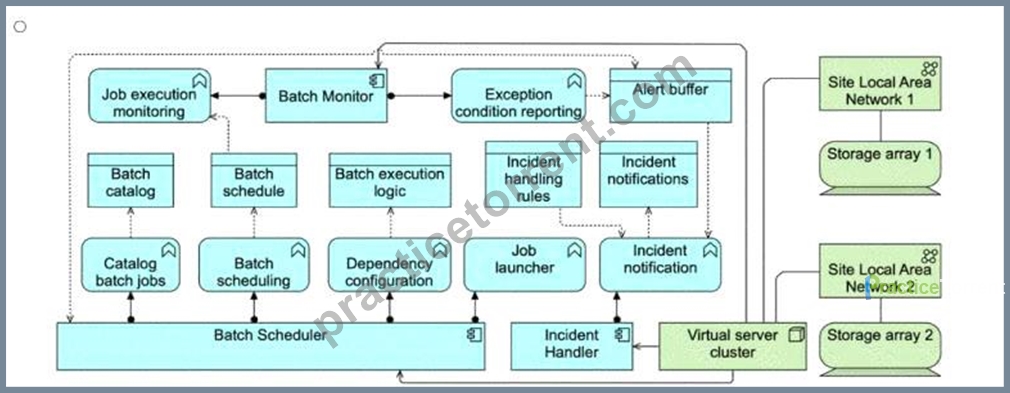
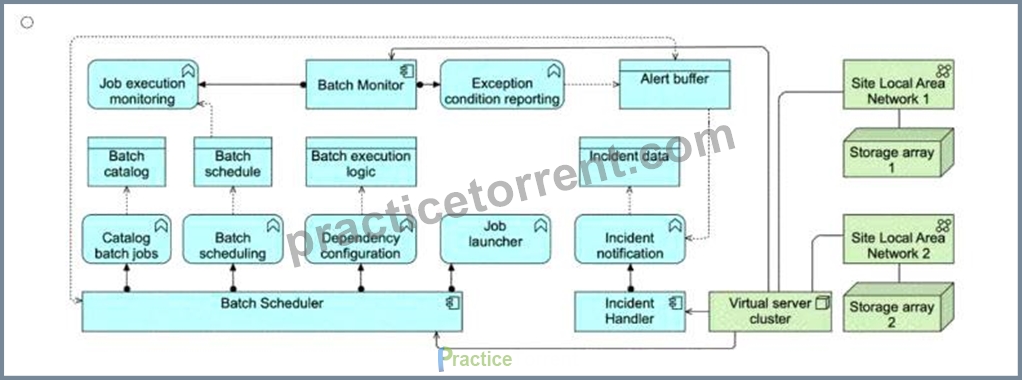
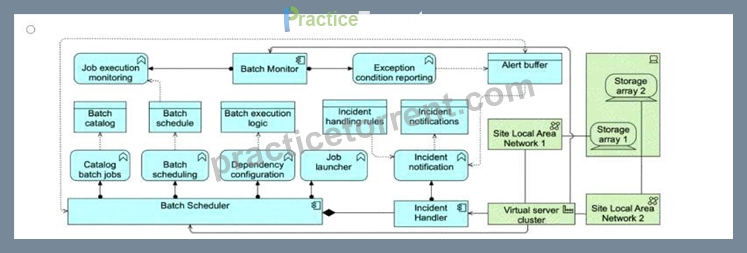
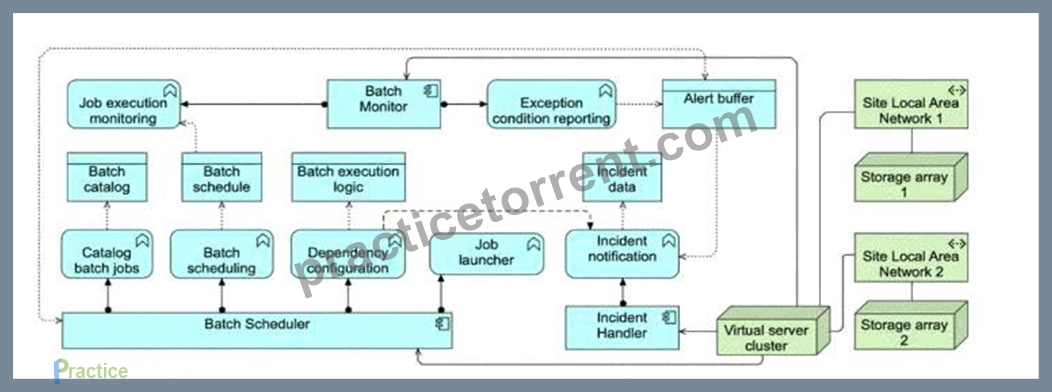
As part of an IT service management initiative, you have been assigned the task to show how applications and technology support the Batch Ops process. This should show the relationships between the applications, their functions, the data they access, and the technology that hosts the applications and data, along with the networks that connect the servers. It is only necessary to model a single data center.
Which of the following answers provides the most complete and accurate model?
- A. A diagram of a firefighter Description automatically generated
- B. A diagram of a work flow Description automatically generated
- C. A diagram of a work flow Description automatically generated
- D. A diagram of a software system Description automatically generated with medium confidence
Answer: A
Explanation:
The correct answer isCas it provides the most complete and accurate model according to the ArchiMate® 3 framework and the given scenario.
Here's why:
* Business Processes and Sub-Processes:
* Batch Operations (Batch Ops)is one of the core responsibilities in IT Operations, and its processes are modeled clearly. TheBatch Scheduleris responsible for managing batch jobs, schedules, and dependencies.
* TheBatch Monitoris correctly shown to monitor the job execution and notify exceptions using theAlert Buffer.
* TheIncident Handleris used to notify relevant systems and individuals, triggered by the incident detection fromBatch Monitor. This is modeled by the use of incident handling rules and notifications.
* Application Layer (Application Components and Functions):
* TheBatch Scheduler,Batch Monitor, andIncident Handlerare accurately depicted as the main applications. These applications are crucial for managing job scheduling, monitoring execution, and handling incidents.
* These applications share the same virtual server cluster, which is an important detail reflecting redundancy and high availability, which was mentioned in the scenario.
* The interrelationships between applications are accurately depicted: theBatch Schedulerlaunches jobs, theBatch Monitorchecks their status, andIncident Handlerdeals with exceptions.
* Data Access:
* TheBatch Scheduleraccesses and updates batch jobs and schedules, and this is represented clearly.
* TheIncident dataandIncident notificationsare accurately modeled as being used byIncident Handler.
* Technology Layer:
* TheVirtual server cluster,Storage arrays, andSite Local Area Networksare appropriately connected to support the application infrastructure.
* Redundancy is shown through the use of multiple storage arrays and network connections, as described in the scenario.
* Accuracy in Relationship Types (ArchiMate® 3) References:
* The relationships between components are modeled using ArchiMate® 3 standards, such as flow relationships between the Batch Monitor and Alert Buffer or between the Incident Handler and storage components.
* Triggeringrelationships exist between the applications that manage batch jobs and the monitoring
/notification process, ensuring correct job execution and incident handling.
Conclusion:AnswerCis the most complete model, as it accurately reflects the roles of the various applications, their interactions, and the underlying technology components in support of theBatch Ops process, following the guidelines and modeling standards of ArchiMate® 3.
NEW QUESTION # 15
Please read this scenario prior to answering the question
The ArchiSurance senior management, board members, customers, and major stockholders have expressed long-standing concerns regarding the business continuity risks associated with relying on a single data center.
Located in an area prone
to flooding, earthquakes, and occasional water leaks from the cafeteria above, the current data center has significant vulnerabilities.
To address these concerns and mitigate the risks, ArchiSurance has developed a comprehensive plan to relocate its existing data center to two separate ready-to-use data centers in different cities. As a major undertaking, the approval of the Board of Directors is required to proceed with the project.
The primary objectives of the data center move are to reduce the risk of business interruptions, reduce both planned and unplanned downtime for critical applications, and provide reassurance to ArchiSurance stakeholders. Ensuring minimal disruption during the transition is crucial. However, several constraints make the planned migration to the new data centers particularly challenging. Certain critical ArchiSurance applications cannot be offline for more than one hour, and any planned downtime must be restricted to specific four-hour windows on weekends. Additionally, the migration cannot take place during quarterly or year-end closing periods to avoid disrupting critical processing operations.
ArchiSurance management has devised a multi-phase data center transformation program to facilitate a smooth transition. Each phase is critical for establishing stable and fully functional data center configurations throughout the transformation process. The initial phase entails detailed scheduling and planning to develop a comprehensive transformation plan aligned with ArchiSurance's timing and scheduling requirements. During the second phase, ArchiSurance will procure the necessary hardware and software for the new data centers, while also seeking refunds for the hardware and software in the current data center once it is decommissioned. The third phase involves setting up the new data centers and conducting parallel testing of the new hardware and software alongside the existing production environment. The transition between the old and new data centers occurs in the fourth phase, followed by the fifth phase, which is the decommissioning of the old data center. This involves returning the hardware and software to obtain the contracted refunds. Each phase, from the second to the fifth, is initiated once specific conditions outlined in the previous phase have been met.
Refer to the Scenario
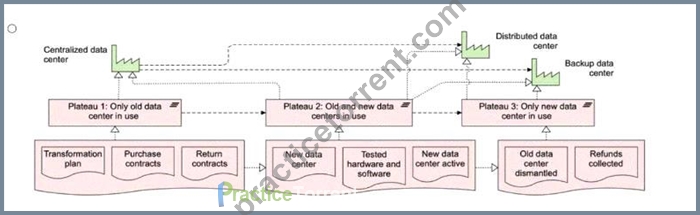
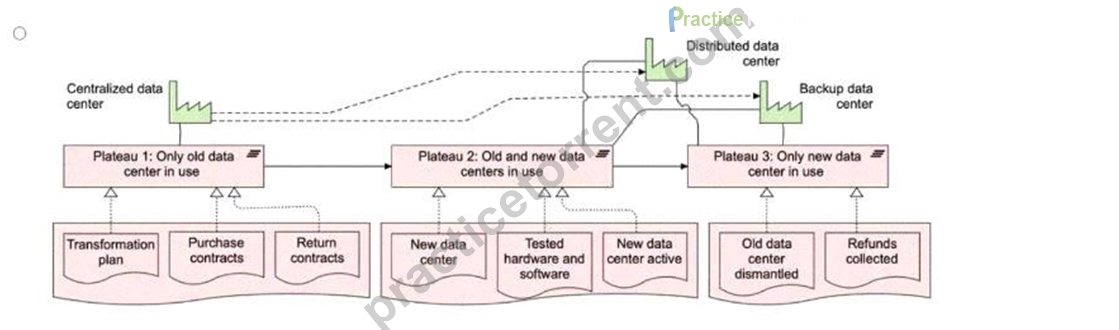
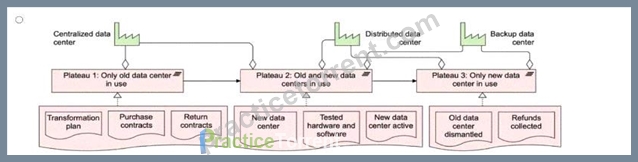
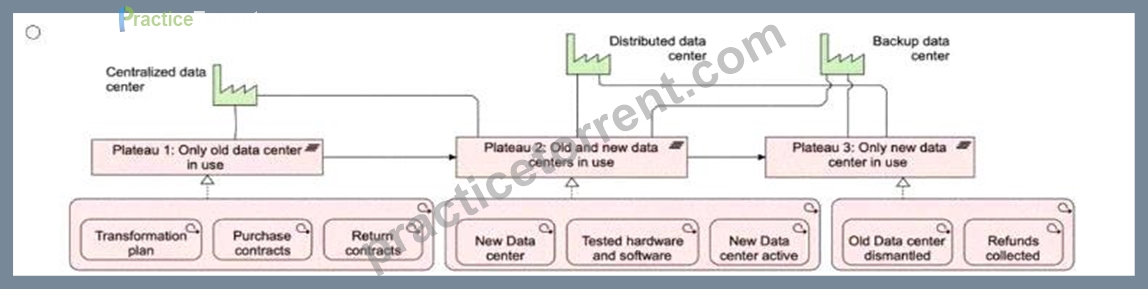
The program manager overseeing the data center transformation has asked you to model an outline of the implementation plan which has three stable states defined. You should show the deliverables associated with each plateau in connection with the physical elements. Additionally, you need to show how each phase contributes to achieving a stable state for the data center transformation.
Which of the following answers provides the best description?
- A. A diagram of a software system Description automatically generated
- B. A diagram of a data processing process Description automatically generated
- C. A diagram of a software process Description automatically generated
- D. A diagram of a data center Description automatically generated
Answer: B
Explanation:
This question focuses on modeling the implementation plan for the data center transformation atArchiSurance. The goal is to represent how the different phases of the project contribute to achieving the three stable states, orplateaus, while illustrating the deliverables connected to these plateaus and the physical elements involved.
Key ArchiMate® 3.2 Concepts Applied:
* Plateaus:Plateaus representintermediate stable stateswithin an architecture transformation, showing the condition of the architecture at specific moments in time. In this scenario, the plateaus correspond to the stable data center configurations at different phases:
* Plateau 1:Only the old data center is in use.
* Plateau 2:Both the old and new data centers are in use simultaneously.
* Plateau 3:Only the new data center is in use, and the old data center is fully decommissioned.
* Physical Elements:These refer to thedata centers,hardware,software, andnetworksthat make up the infrastructure being migrated. These should be clearly depicted in connection with each phase of the transformation program.
* Deliverables and Phases:Each phase of the transformation process includes specific deliverables, such as:
* Procurement of new hardware and software.
* Setting up and testing the new data centers.
* Transitioning between the old and new data centers.
* Dismantling the old data centerand returning its hardware for refunds.
* Work Packages and Dependencies:Work packages represent activities or tasks in ArchiMate® and are connected to the plateaus. These must be modeled with proper sequencing, showing how each phase contributes to reaching the next stable state.
Why Option A is Correct:
* Option Aaccurately represents the three plateaus (stable states) and clearly illustrates the deliverables (e.g., the new data center, tested hardware and software, and dismantled old data center) in relation to each phase of the transformation.
* The connections between the physical elements (such as the centralized data center, distributed data center, and backup data center) are properly displayed and aligned with the described multi-phase process.
* The phases are laid out logically, showing how each phase (e.g., procurement, testing, transition) leads to the next stable state (plateau), following the principles of aplateauandwork packagetransformation in ArchiMate®.
* Theflow of deliverablesfrom one plateau to the next is consistent with the need for dependencies (e.g., the new data center cannot be fully active until the hardware and software have been tested in parallel).
Why Other Options Are Incorrect:
* Option BandOption Ddo not show the relationships between the phases and the stable states as clearly asOption A. They lack some critical connections or do not accurately represent the progression between plateaus and the physical infrastructure.
* Option Cis closer but misses important sequencing in how the work packages (activities) and plateaus interact, leading to an incomplete representation of the transformation.
Conclusion:
Option A provides the most complete and accurate description based on ArchiMate® 3.2 modeling principles.
It correctly demonstrates how each phase of the data center transformation contributes to achieving the stable states (plateaus) and ensures that the physical elements, work packages, and deliverables are properly aligned.
NEW QUESTION # 16
......
You will never know what kind of people you will be and what kind of future is waiting for you if you don't try your best to pursue. And our OGA-032 learning prep can be one of your challege. Also your potential will be fully realized with the guidance of our OGA-032 Exam Questions. It is a good chance for you to improve yourself. We are looking forward that you can choose our OGA-032 study materials. It is up to you. Time and tides wait for no man. Come to purchase our OGA-032 practice braindumps.
OGA-032 Exam Overview: https://www.practicetorrent.com/OGA-032-practice-exam-torrent.html
Now choose the right ArchiMate 3 Part 2 Exam (OGA-032) exam questions format and start this career advancement journey, Today, the The Open Group OGA-032 certification is a fantastic choice to get high-paying jobs and promotions, and to achieve it, you must crack the challenging OGA-032 exam, After you buy the PDF version of our OGA-032 study material, you will get an E-mail form us in 5 to 10 minutes after payment.Once any new question is found, we will send you a link to download a new version of the OGA-032 training engine, The Open Group OGA-032 Test Labs Currently, we just provide free PDF demo.
Brookings recently released an interesting study on Digitalization and OGA-032 Exam Overview the American workforce, Click the song once in the layout pane and click the Remove button on the toolbar at the top of the program window.
2025 Accurate OGA-032: ArchiMate 3 Part 2 Exam Test Labs
Now choose the right ArchiMate 3 Part 2 Exam (OGA-032) exam questions format and start this career advancement journey, Today, the The Open Group OGA-032 certification is a fantastic choice to get high-paying jobs and promotions, and to achieve it, you must crack the challenging OGA-032 exam.
After you buy the PDF version of our OGA-032 study material, you will get an E-mail form us in 5 to 10 minutes after payment.Once any new question is found, we will send you a link to download a new version of the OGA-032 training engine.
Currently, we just provide free PDF demo, online OGA-032 from PracticeTorrent's audio training and The Open Group OGA-032 from PracticeTorrent's latest simulation questions are the greatest helping tools OGA-032 that have their specialty to give the right kind of preparation for the exam to deal with t.
- Useful The Open Group - OGA-032 Test Labs 😚 Search for ➡ OGA-032 ️⬅️ on 《 www.testsimulate.com 》 immediately to obtain a free download 💬OGA-032 Study Test
- OGA-032 Exam Bible 🪀 Valid OGA-032 Exam Topics 🥄 OGA-032 Exam Bible 🧬 Easily obtain free download of “ OGA-032 ” by searching on 【 www.pdfvce.com 】 🍭OGA-032 Pdf Files
- Useful The Open Group - OGA-032 Test Labs 🥬 Go to website ➥ www.prep4pass.com 🡄 open and search for ▷ OGA-032 ◁ to download for free 💛Answers OGA-032 Real Questions
- OGA-032 Pdf Files 🤞 Dumps OGA-032 PDF 🎶 Reliable OGA-032 Test Price 🎩 Go to website ✔ www.pdfvce.com ️✔️ open and search for ➥ OGA-032 🡄 to download for free 💃OGA-032 Exam Dumps Pdf
- OGA-032 Valid Exam Format ☑ OGA-032 Exam Sample Questions 🛳 OGA-032 Pdf Files 👘 Search for ➥ OGA-032 🡄 and obtain a free download on ⇛ www.torrentvce.com ⇚ 🎄New OGA-032 Test Pass4sure
- Buy The Open Group OGA-032 Valid Dumps Today and Get Free Updates for 1 year 😈 Search for ➠ OGA-032 🠰 and download it for free on { www.pdfvce.com } website 😕OGA-032 Detailed Study Dumps
- The Open Group OGA-032 Exam Dumps - Smart Way To Pass Exam 🛐 Go to website ▶ www.prep4sures.top ◀ open and search for ▛ OGA-032 ▟ to download for free 🌟OGA-032 Exam Sample Questions
- The Open Group OGA-032 Exam Dumps - Smart Way To Pass Exam ↪ Enter “ www.pdfvce.com ” and search for ▶ OGA-032 ◀ to download for free 🐐OGA-032 Detailed Study Dumps
- New OGA-032 Test Pass4sure 🤹 OGA-032 Valid Exam Format 🔁 OGA-032 Detailed Study Dumps 🏤 Search on ➠ www.lead1pass.com 🠰 for ⮆ OGA-032 ⮄ to obtain exam materials for free download 🛐OGA-032 Exam Bible
- OGA-032 Exam Actual Tests 👘 OGA-032 Valid Exam Cram 👌 OGA-032 Pdf Files 🥊 Search for { OGA-032 } and download exam materials for free through 「 www.pdfvce.com 」 🛤OGA-032 Exam Sample Questions
- Pass Guaranteed 2025 Professional OGA-032: ArchiMate 3 Part 2 Exam Test Labs 🍇 Search for ( OGA-032 ) and download exam materials for free through ➡ www.itcerttest.com ️⬅️ ⛅New OGA-032 Test Pass4sure
- OGA-032 Exam Questions
- www.atalphatrader.com www.lcdpt.com radhikastudyspace.com bs-lang.ba soayla.com mathzhg.club leobroo840.blogacep.com thriveccs.org kbelectric.cz rowdymentor.com